Mercury Arc Rectifiers
Mercury arc rectifiers (also known as Cooper-Hewitt or Hewittic
rectifiers) were extensively used to provide DC in high power applications, powers ranging
from kilowatts up to a few megawatts, at voltages ranging from 110V to 30KV. Their
operation is based on the discovery that an arc between a pool of mercury and a metal
anode only allows current to pass in one direction. Multiple anodes are typically used,
fed from a multiple-phase transformer, the arc jumping from the cathode pool to each anode
in sequence. There may be three, six or even twelve transformer phases, each feeding one
anode. Six and twelve-phase systems used star-connected three-phase transformers with
interphase transformers between the star common connections.
Construction is either a glass bulb, as shown in the pictures below,
cooled by an external fan or water jacket, or a steel tank for very large units with
capacities above about 500 amps.
To initiate the arc, an ignitor is used, typically consisting of an
electrode which can be dipped in the mercury pool using an external electromagnet. The
ignitor draws a small spark to ionise the mercury vapour, initiating the main arc.
Mercury arc rectifiers have now been made totally obsolete by
semiconductors, although there are a few still in service in old installations. I recently
(Jan 2002) saw a working installation on display at the Museum of Transport &
Technology in Auckland, New Zealand, where they use two banks of 4 big glass MARs to
provide DC to run their tram service - you could see the arc glow intensity changing in
intensity as the tram changed speed!
New! Want to know more ?
Check out these Detailed articles on Mercury Arc Rectifiers
from old engineering publications. Also see this advertisment
for a small 'Nevitron' single-pase MAR. More technical info in this 1964 book
Installation and Maintainance instructions for Hackbridge & Hewittic
Group Ltd. MARs :
Small single-bulb types 40/100,100/200 and 100/200ET
Large single-bulb types ST
Group bulb units type GT and 1/2GT
German MAR page
(Incidentally, the German for MAR is "quecksilberdampfgleichrichter")
Thanks to Jake Purches for this interesting snippet : I was talking about Mercury
Arc rectifiers with my neighbour who is a former electrical engineer, now 85 years old.
One of his jobs was to install Mercury arc rectifiers and he explained to me how they came
delivered upside down, with the mercury, a quart in all, would be sitting in the large
glass bulb. He said the trick was to invert the bulb very carefully to make sure the
mercury would flow into the base cap and NOT into the rectifier arms! If the mercury did
enter an arm, the weight of it would snap it off and a quart of mercury would be shooting
out all over the place, which did happen occasionally. This job was left to the
experienced chaps of course. The MARs themselves would be delivered in crates that had a
hammock arrangement so that the MAR bulb would be hanging, or suspended to avoid shock.
The light from them was extremely bright of course, and probably very strong in the UV
spectrum too.
The picture below is the tiny mercury arc rectifier in my glassware collection, which is
from a welder (bulb approx. 4" diameter). This had an outer electrode consisting of a
conductive coating, most of which has fallen off. I believe this was used as an ignitor,
presumably with a high voltage impulse or RF drive to ionise the mercury vapour and
initiate the arc. If anyone knows the rating of this type of bulb, please let me
know!


Big glass-bulb mercury arc rectifiers : 3 phase unit approx. 18" high, Siemens Museum, Munich
(Left), and 6-phase rectifier, approx. 36" high, Deutsches Museum, Munich.


Circuit diagram of mercury-arc rectifier unit.

(left) Large 12-phase steel-tank rectifers, each supplying 4000
Amps at 420V, English Electric Co., (right) working rectifier on display at the Cambridge Museum of Technology, UK


Thanks to Nick Catford for the
picture below, showing one of two MARs still in service (Jan 2001), powering a lift in
Belsize Park, London. The blade of the cooling fan can be seen immediately below the bulb.

Thanks to 'nasadowsk' for the following : The NYC subway system still uses
these in a few locations, but is converting to solid state. They also use mechanical AC-DC
conversion on some of the oldest (90+ years) lines. A number of railroads in the US
experimented with mercury Arcs (commonly called ignitrons* here), notebly the Virginian,
Pensylvainia, and New Haven. The idea was to use
commonly available 60hz ac power, instead of the 25 hz that A.C. electric trains required
at the time. Early applications were freight, but later passenger trains had them. New
haven's stuff was plagued by complexity (the trains had to support not only 11kv 25hz AC
overhead, but 600V dc third rail), and fires (this is bad publicity, and rather annoying
too). Ultimately, they fixed these problems, but by then, solid state equipment was
available.
But the advantages of rectifer locomotives and trains weren't had - Virginian depowered in
the 60's, New Haven depowered all but 2 lines, and the PRR never converted to 60 hz, and
ultimately abandoned rectifers for all but suburban lines. Today, only Metro-North, which
now runs the former New Haven line, takes full advantage of the technology - they
converted to 60hz AC in 1983. (Note on power: the US uses 60hz AC, instead of 50 like the
rest of the world)
* Ignitrons are controllable mercury-arc rectifiers, which operate rather like modern
thyristors, using a trigger signal to control a large current. They are still used in some
very high power applications.

From Stephan Meyn : I recently ran into this Mercury Arc Rectifier
in a museum in Kandos, NSW Australia. It was used to charge the batteries for the coal
mine's electric engines. As you can see by the person next to it it is about 4 foot in
size.

Another type of small mercury-arc rectifier - the 'Rectigor'

Thanks to Anthony Richards for this picture of one of 28 Steel-tank MARs
still in service (Jun 2002) driving 1200hp motors in a bar rolling mill in Newcastle,
Australia.

Thanks to Robert Reay for this pic from an old book of a portable MAR
based DC supply unit. I suspect moving it whilst operating would have been a bad idea due
to the mercury sloshing about....
The excellent Amberley Museum has recently acquired a MAR
with all its control gear, made by Hackbridge & Hewittic Electric, and are planning to
get it into a working condition for demonstrations. Remarkably, it was in service up until
January 2005, a working life of well over 50 years! This was part of a battery charging
system at a power substation at Croydon (South London).

Rectifier in cubicle.

Part of the battery control gear - a semi-automatic tap-changer (this
unit is about six feet high). Two huge solenoids operate a rotary switch arrangement,
which includes resistance coils to keep the current flowing as the switch moves between
contacts.

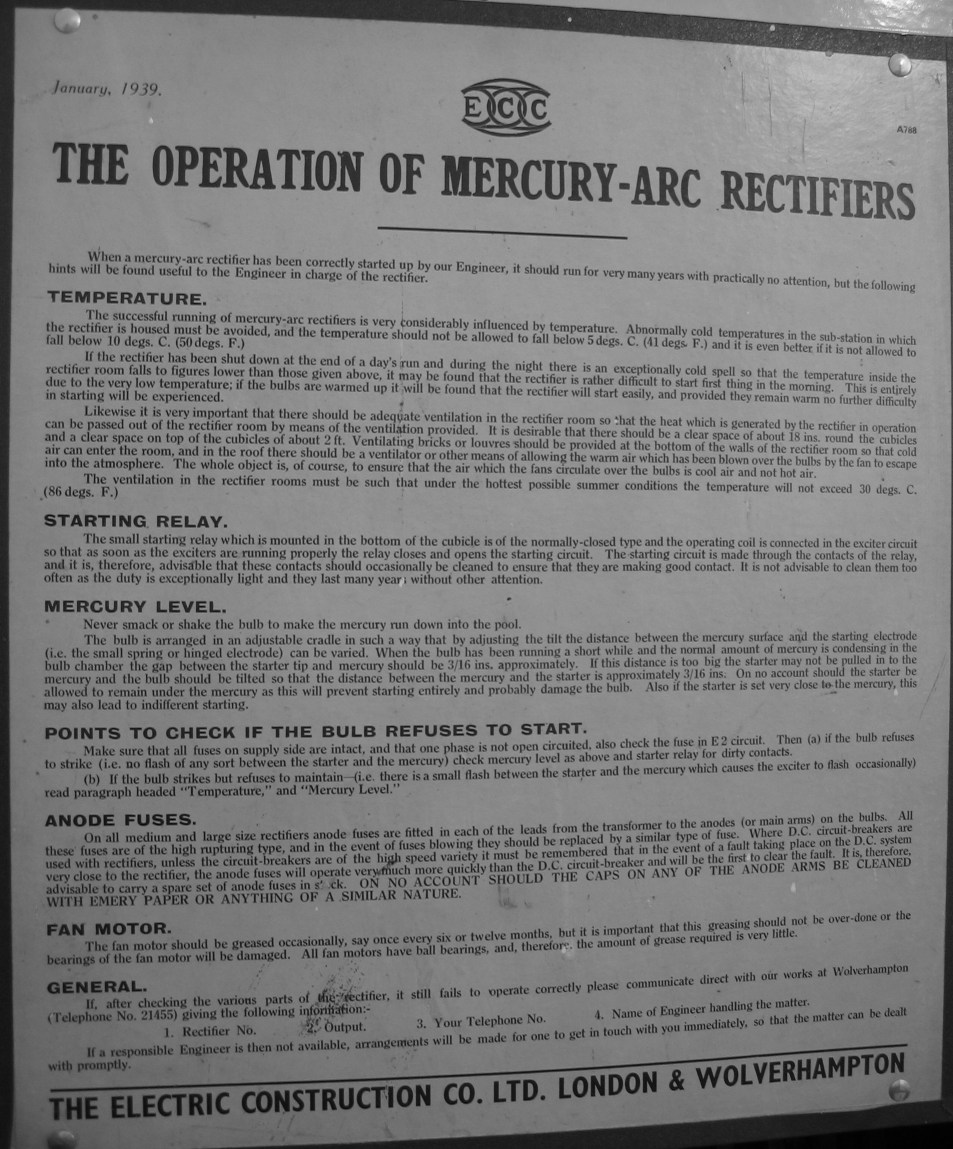
Operating instructions - click image to see full-res version.
Tungar rectifiers
These were small gasfilled rectifiers, used for low-voltage applications
such as battery chargers. The one pictured below is marked "Edison-Swan Electric
68506". The small black device shown underneath is the modern semiconductor
equivalent!