Fun with lasers
A while ago I got hold of an argon-ion laser This produces a blue beam at 488nm wavelength, at an estimated power of about 20-40 milliwatts. I started wondering what fun things I could do with it that you can't do with the more common helium-neon or diode lasers.... Here's what I've thought up so far - if anyone has any other suggestions, let me know! One thing you need when messing with lasers is a source of smoke - check out this artificial smoke from Maplin.
Laser Fluorescence
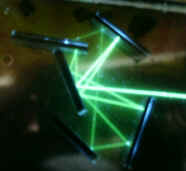
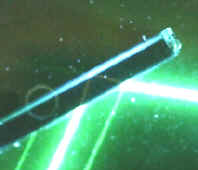
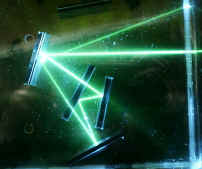
I noticed that if I pointed the laser at some fluorescent ('dayglo') paper, it shone brightly - I'd always thought of fluorescence only happening with ultra-violet light. This got me thinking about other fluorescent things, and the first thing to hand was some car screen-wash additive. Shining the beam through the neat solution was rather disappointing, just giving a bright spot where the beam entered the glass jar. However, when I diluted it, the effect was spectacular - an intense green beam in the water. This only required a tiny amount of dye - the tint being hardly visible under normal light. This effect is best demonstrated in flat-sided glass or plastic trays, as curved-sided vessels will defocus the beam. You can get some really neat effects with a few mirrors & other optical bits placed in the water.....
Total Internal reflection - an angled mirror bounces the beam off the surface & bottom of the tank.
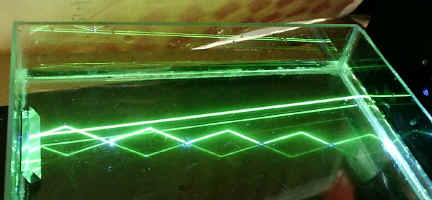
L-to-R: 1: mirror mayhem! 2: main and surface reflections from a back-silvered mirror. You can also see a feint glow within the glass fluorescing (from the sodium content?). 3: one way mirror - the beam appears to pass through the centre mirror, but later bounces off it - actually the beam is angled upwards, so it jumps over it, reflecting off the surface of the water.
I also tried dyes from some fluorescent highlighter pens, by dabbing them on tissue paper to draw the ink out, then dipping them in water and squeezing out. Green and orange markers produced some effect, but nowhere near as good as the screenwash. However, when I tried pink, something very odd seemed to be happening.....
Initially, it gave a very nice orange glow, but when I moved the plastic tray, (so the beam entered through a different part of the wall), the colour of the beam in the water changed dramatically, from orange to blue. After some head-scratching, I realised that the only thing that could possibly have changed when the tray was moved is any polarisation twist that ocurred in the plastic. (Many transparent plastics affect the polarisation of light passing through them - this can be demostrated by placing polarising filters each side and passing light through - you often see rainbow colours, especially at edges, where the plastic is stressed during manufacture.)
Up until this, I didn't even know that the laser had a polarised output!, but a quick
check with a polarising filter confirmed this. Further experimentation revealed that as
you viewed the beam from different angles (perpendicular to the beam path), the apparent
beam colour changed. I can only assume that this colour change resulted from the
polarisation of the fluorescent light having a different orientation to that from the
scattered original blue light, so at different angles you see a different mix of these
colours.
A very neat effect can be seen by placing the glass part of a liquid crystal display, with
the polarising filters removed, in the tank - you see a dramatic colour change as the beam
passes through the glass, which rotates the polarisation of the beam. If you apply a
voltage to the LCD panel, you can electrically switch the colour as the polarisation twist
changes!
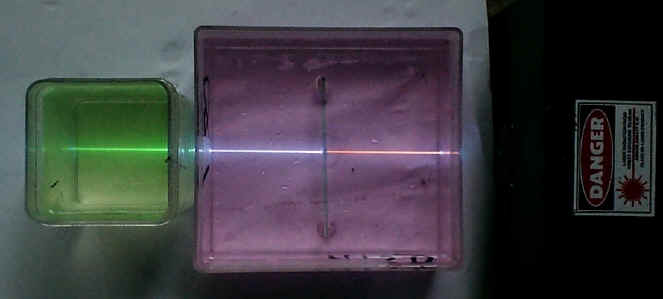
This image shows the beam passing through two trays of water containing small amounts of fluorescent dye, with the beam coming in from the right. The left-hand container has a green fluorescent dye from car screenwash additive. The one on the right contains dye from a pink fluorescent highlighter pen. In the centre of this container is the glass panel from a liquid crystal display, with the polarisers removed. This twists the polarisation of the beam, resulting in a dramatic change in the apparent colour. The change is slightly more than it appears in this image - the left part is bluer, and the right half more orange - my digital camera seems to get confused by laser beams!